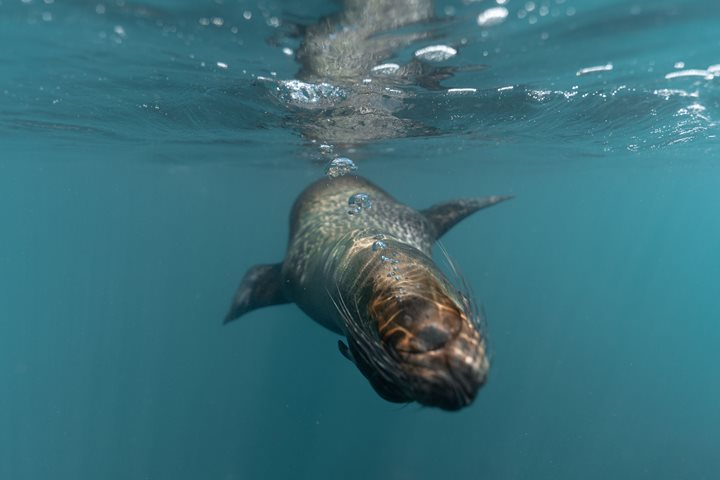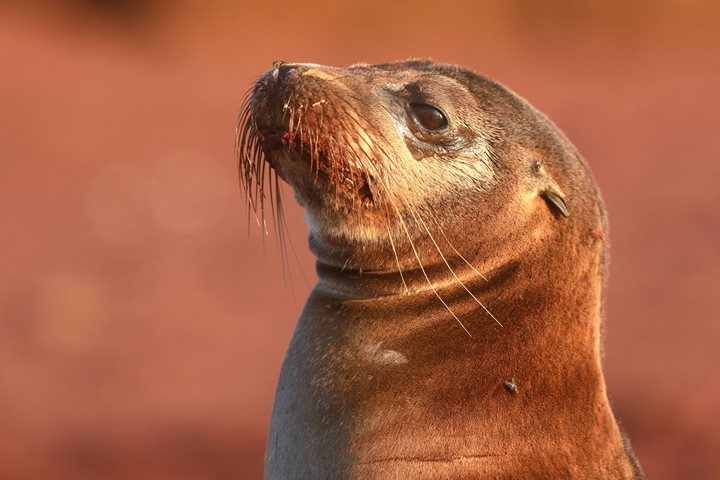
Our first full day brings us to the realization that this is truly a world among itself. Anchoring early in the turquoise waters that surround Española, we started our day exploring the undersea world. Rays, sea lions, large schools of fish all went about their day uninterested in our presence. Eventually landing on this island allowed us to walk among the sea lions and curious mocking birds. A short navigation to our afternoon site allowed us to experience the ecologically naïve creatures on land. The endemic waved albatross and its incredible life history intertwined with Nazca boobies, blue footed boobies and screaming tropic birds overhead gave us a connection with nature that can change anyone. The sunset sends us on our way with a better understanding of life in this archipelago.
- Daily Expedition Reports
- 04 Dec 2017
Española Island, 12/4/2017, National Geographic Islander
- Aboard the National Geographic Islander
- Galápagos
Jason Heilmann, Undersea Specialist
Growing up in northern California, Jason was surrounded by the incomparable nature of the Pacific Northwest. While attending university there, Jason met and eventually married an Ecuadorian woman who happened to be from a small group of islands off t...
Read MoreShare Report
Related Reports
11/23/2022
Read
National Geographic Islander II
Isabela and Fernandina
Our day began with the chance to point out a lot of interesting geological features as we enjoyed Zodiac tours along a massive flank of Ecuador Volcano on Punta Vicente Roca. In the afternoon, we took a sunny walk on Punta Espinoza on Fernandina Island. We spotted many iguanas, and a bunch of sea lions hanging around, too.
11/22/2022
Read
National Geographic Islander II
North Seymour & Rabida Islands
Relatively small and low compared to neighboring Santa Cruz, North Seymour is located to the north of Baltra. The island is dry with predominantly low shrubs, like prickly pear cacti. The incense trees are bare during the dry season. Seabirds like frigatebirds and blue-footed boobies nest on the island, and sea lions rest on the sand when they are not fishing. Land and marine iguanas also live here. Rabida is in the middle of the archipelago and has a striking red sand beach. We observed a small colony of sea lions of all ages resting or nursing. Behind the beach, American flamingos nest in a brackish lagoon. This island is full of contrasts and wildlife that we enjoyed observing during this day of expedition.